Blue Mbuna
Labeotropheus fuelleborni
Also known as: Fuelleborn's cichlid
A rock-grazing Lake Malawi cichlid with a bold personality and remarkable color diversity.

About
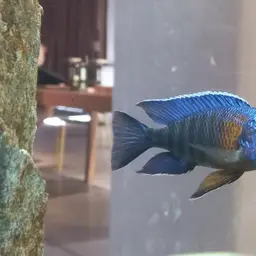
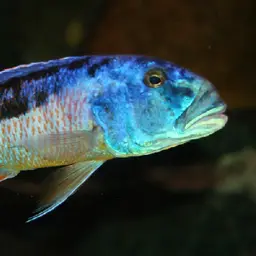
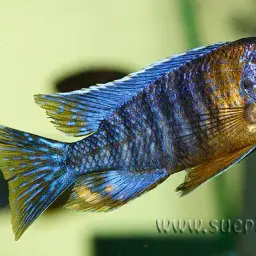
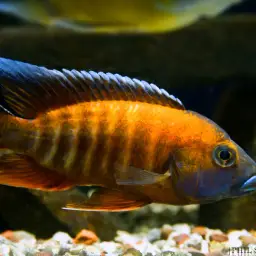
The Blue Mbuna (Labeotropheus fuelleborni) is one of the more recognizable members of the mbuna group from Lake Malawi, distributed widely across the lake and its offshore islands. It's immediately identifiable by its distinctively overhanging snout. A physical trait shared across its genus that allows it to press flat against rocky surfaces and scrape algae even in the turbulent shallows where other fish can't easily feed. The chisel-shaped teeth are purpose-built for this lifestyle. In the wild it usually grazes solo or in small mixed groups, though large raiding schools of several hundred individuals have been documented descending on algae-rich territories claimed by other species. This species comes in a remarkable range of color forms, including several female morphs and the rare orange-blotch males sometimes called "marmalade cats." Males can shift color rapidly under stress or excitement, which makes them particularly watchful fish to keep. In the aquarium, this is not a community fish for the faint-hearted. It is genuinely aggressive toward its own kind and incompatible with gentler cichlids like peacocks. The standard advice holds true here: overstock the tank, keep multiple females per male, and mix with other robust mbuna species to spread aggression around. An intermediate-level species, it rewards attentive keepers with real personality and a surprising tendency to recognize familiar faces.
Similar species
Other fish you might consider
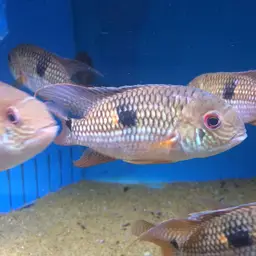
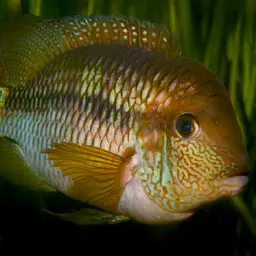
Good tank mates
Species that tend to coexist peacefully with Blue Mbuna
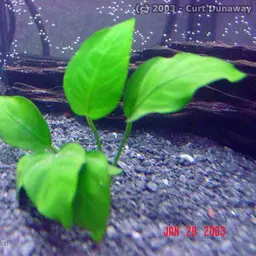
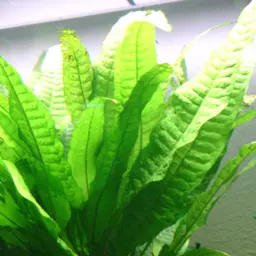
From the same region
Share the same natural habitat. Great for a biotope-themed tank
Frequently asked questions
- How big does the Blue Mbuna get?
- The Blue Mbuna reaches about 4.5–9" as an adult.
- What size tank does the Blue Mbuna need?
- A minimum of 42 gallons is recommended for the Blue Mbuna.
- What water parameters does the Blue Mbuna need?
- The Blue Mbuna does best with a temperature of 72–82°F, a pH of 7.5–8.5, hardness around 10–25 dGH.
- Is the Blue Mbuna aggressive?
- The Blue Mbuna is aggressive and is best kept alone or with robust tankmates that can hold their own.
- What does the Blue Mbuna eat?
- The Blue Mbuna is an omnivore. It does well on a varied diet of quality flake or pellet plus occasional frozen or live foods.
- How long does the Blue Mbuna live?
- With good care, the Blue Mbuna typically lives 8-12 years.