Panda Clownfish
Amphiprion polymnus
Also known as: brownsaddle clownfish, Saddleback Anemonefish, Saddle Back Clown, saddleback clownfish, White-tipped Anemonefish
A boldly patterned clownfish with a preference for sandy, silty homes.

About
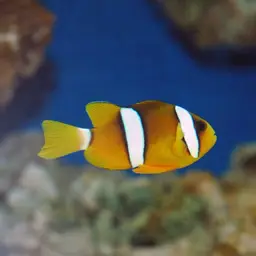
The saddleback anemonefish (Amphiprion polymnus) is one of the more distinctive clownfish you'll encounter, wearing a dark brown to near-black base coloration interrupted by a broad white head bar and a second partial white bar that sweeps across the mid-body like a saddle. Hence both of its popular common names. A third white marking sometimes extends along the upper tail. The contrast is sharp and the pattern is variable enough that no two fish look quite identical. In the wild, this species ranges widely across the Western Pacific, from the Ryukyu Islands and Taiwan down through the Philippines, Indonesia, and into Australian waters. Unlike many clownfish that favor pristine coral environments, saddlebacks tend to settle in silty lagoons and harbors, pairing with Heteractis crispa or Stichodactyla haddoni anemones. They're monogamous and protandrous hermaphrodites, meaning the dominant fish in a pair becomes female. A trait shared with other clownfish. Eggs are laid on hard substrate near the anemone and guarded attentively by the male. In a home aquarium, saddlebacks generally get along with other peaceful species, though like most clownfish they can become territorial around their chosen host. They're a reasonable choice for intermediate keepers who can provide a compatible anemone and stable water conditions.
Similar species
Other fish you might consider
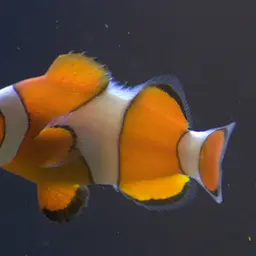
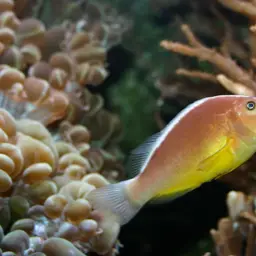
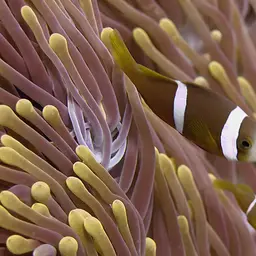
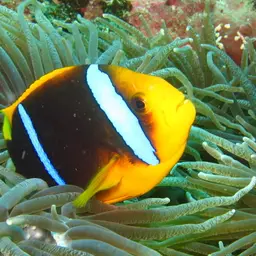
From the same region
Share the same natural habitat. Great for a biotope-themed tank

Frequently asked questions
- How big does the Panda Clownfish get?
- The Panda Clownfish reaches about 3–4.5" as an adult.
- What size tank does the Panda Clownfish need?
- A minimum of 30 gallons is recommended for the Panda Clownfish.
- What water parameters does the Panda Clownfish need?
- The Panda Clownfish does best with a temperature of 72–82°F, a pH of 8–8.4.
- Is the Panda Clownfish aggressive?
- The Panda Clownfish is semi-aggressive. It can work in a community with careful tankmate choices and enough space.
- What does the Panda Clownfish eat?
- The Panda Clownfish is an omnivore. It does well on a varied diet of quality flake or pellet plus occasional frozen or live foods.
- How long does the Panda Clownfish live?
- With good care, the Panda Clownfish typically lives 2-12 years.
- Is the Panda Clownfish reef safe?
- The Panda Clownfish is generally considered reef safe.