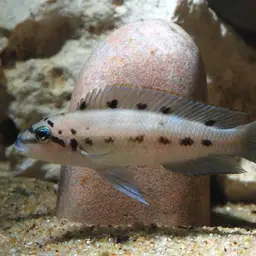
Bigeye Xenotilapia
Xenotilapia sima
Also known as: Big-eyed Xenotilapia
A sand-sifting Tanganyikan schooler that rarely turns up in the hobby

About
Found over the sandy lake beds of Lake Tanganyika, Xenotilapia sima is a slender cichlid that earns its carnivore label in an interesting way. It scoops up mouthfuls of substrate and filters invertebrates and organic matter through its gills, much like the South American eartheaters do. It is not a fish you will find at every shop, but those who track one down tend to appreciate its understated appeal. Despite the aggressive label attached to the species, this is largely a context thing: males turn territorial during spawning, but outside of breeding activity the fish is actually quite skittish and gregarious, doing best in a group of six to ten individuals. Pair it with boisterous tankmates and it will struggle; keep it alongside calmer Tanganyikans like Cyprichromis or peaceful Lamprologus species and it settles in well. The mouthbrooding is maternal, with females carrying the brood for roughly three weeks without feeding, and the species is not commonly bred in home aquaria. Patience and a carefully chosen group of young fish raised together gives you the best shot. The skittishness is real: sudden movements near the tank or abrupt lighting changes can send the whole group into a panic, so a calm, low-traffic placement matters.
Similar species
Other fish you might consider
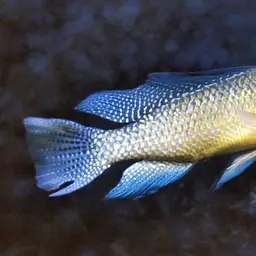
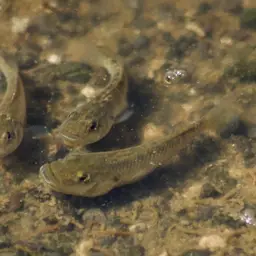
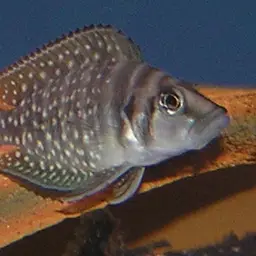
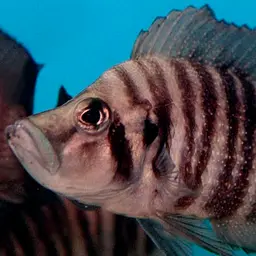
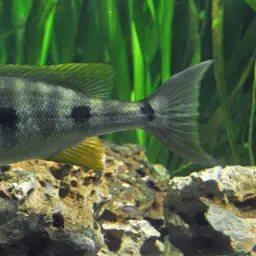
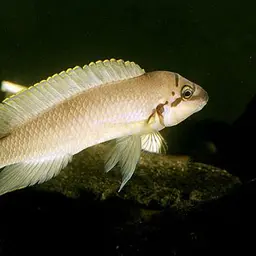
Good tank mates
Species that tend to coexist peacefully with Bigeye Xenotilapia
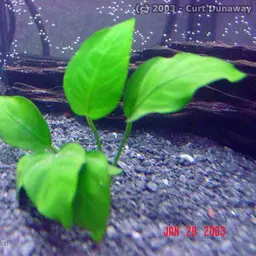
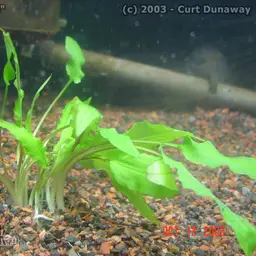

From the same region
Share the same natural habitat. Great for a biotope-themed tank
Frequently asked questions
- How big does the Bigeye Xenotilapia get?
- The Bigeye Xenotilapia reaches about 4–6.5" as an adult.
- What size tank does the Bigeye Xenotilapia need?
- A minimum of 36 gallons is recommended for the Bigeye Xenotilapia.
- What water parameters does the Bigeye Xenotilapia need?
- The Bigeye Xenotilapia does best with a temperature of 75–79°F, a pH of 8–9.5, hardness around 8–25 dGH.
- Is the Bigeye Xenotilapia aggressive?
- The Bigeye Xenotilapia is aggressive and is best kept alone or with robust tankmates that can hold their own.
- What does the Bigeye Xenotilapia eat?
- The Bigeye Xenotilapia is a carnivore. It needs a meaty, protein-rich diet of frozen or live foods.
- How long does the Bigeye Xenotilapia live?
- With good care, the Bigeye Xenotilapia typically lives 5-8 years.