Yellow-faced Angelfish
Pomacanthus xanthometopon
Also known as: Blue-face Angelfish, Yellowface Angelfish, yellowfaced angelfish, Yellowmask Angelfish
A reef-grazing giant whose juvenile and adult forms look like different fish entirely.

About
The blue-face angelfish (Pomacanthus xanthometopon) is one of the more visually dramatic members of a family not short on drama. Adults develop that distinctive yellow face mask edged in vivid blue. A coloration that sets them apart from other large angels in the Indo-Pacific. In the wild, these fish roam coral-rich lagoons, channels, and outer reef slopes from the Maldives east to Vanuatu, often sheltering near caves and overhangs. Juveniles look almost nothing like the adults, sporting the dark body with white and blue banding typical of young pomacanthids, and in nature they settle in very shallow inshore caves where algae grows on the walls. As with most large angels, the transformation from juvenile to adult coloration is a gradual and fascinating process. In the aquarium, smaller individuals, those under around eight inches or so, adapt to captivity more readily than large wild-caught adults. They'll graze live rock for algae and tunicates, so a well-established system suits them well. Temperament-wise, they can get territorial, particularly when they're the biggest fish in the system, so tank mates should be chosen with that in mind. This is a fish that needs genuine space to thrive, both physically and socially.
Similar species
Other fish you might consider
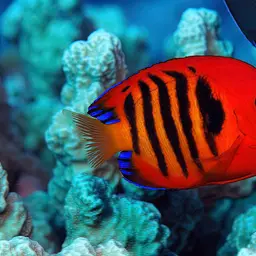
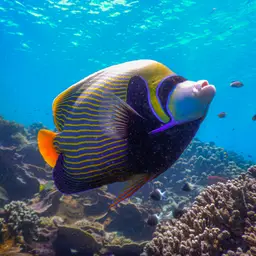
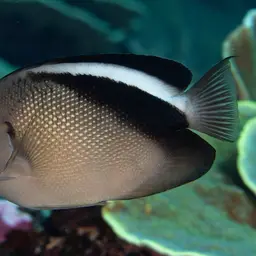
From the same region
Share the same natural habitat. Great for a biotope-themed tank
Frequently asked questions
- How big does the Yellow-faced Angelfish get?
- The Yellow-faced Angelfish reaches about 9–15" as an adult.
- What size tank does the Yellow-faced Angelfish need?
- A minimum of 180 gallons is recommended for the Yellow-faced Angelfish.
- What water parameters does the Yellow-faced Angelfish need?
- The Yellow-faced Angelfish does best with a temperature of 72–82°F, a pH of 8–8.4.
- Is the Yellow-faced Angelfish aggressive?
- The Yellow-faced Angelfish is semi-aggressive. It can work in a community with careful tankmate choices and enough space.
- What does the Yellow-faced Angelfish eat?
- The Yellow-faced Angelfish is an omnivore. It does well on a varied diet of quality flake or pellet plus occasional frozen or live foods.
- How long does the Yellow-faced Angelfish live?
- With good care, the Yellow-faced Angelfish typically lives 5-12 years.
- Is the Yellow-faced Angelfish reef safe?
- The Yellow-faced Angelfish is not considered reliably reef safe and may harm corals or invertebrates.