Acei
Pseudotropheus sp. "Acei"
Also known as: Pseudotropheus sp acei
The only mbuna that feeds exclusively on submerged wood in the wild.

About
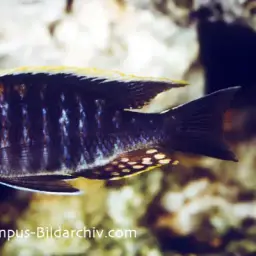
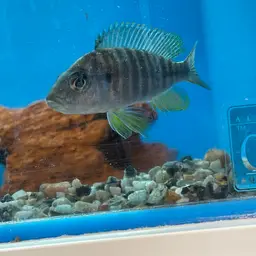
Pseudotropheus sp. acei is one of those happy cases where a fish that's genuinely interesting to keep also happens to be forgiving enough for beginners. Endemic to Lake Malawi, it's distributed along the western shoreline from Nkhata Bay up through Karonga, where it does something no other mbuna is known to do: feed almost exclusively on algae and organisms growing on submerged logs and branches. You'll often find them schooling around woody debris in the lake, which is a real oddity in a group better known for grazing rocks. In the aquarium, that translates to a fish that appreciates wood décor and a diet heavy in vegetable matter. Physically, acei are solidly built cichlids with the bicuspid scraping teeth typical of mbuna, and they come in a couple of distinct color forms. The yellow-tail and white-tail variants are the most commonly traded. Keep those forms separate if you want to maintain their integrity, since they'll hybridize readily. Temperament-wise, this is one of the calmer mbuna around. Males are territorial and can be persistent spawners, but the aggression is noticeably softer than most of its relatives. Running a group with one male and multiple females works well and spreads out his attention. Mouthbrooding females carry eggs for three to four weeks, and the fry are large enough to handle small foods right away.
Similar species
Other fish you might consider
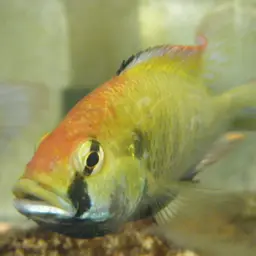
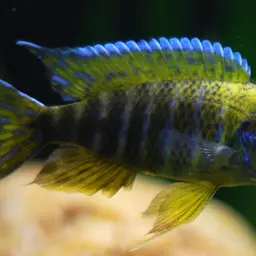
From the same region
Share the same natural habitat. Great for a biotope-themed tank
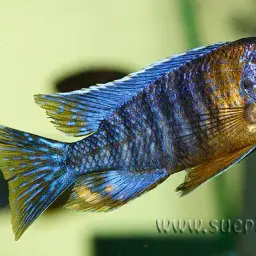
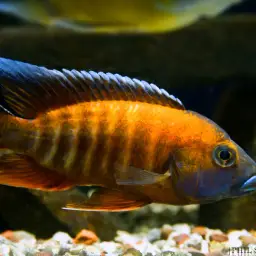
Frequently asked questions
- How big does the Acei get?
- The Acei reaches about 4–5" as an adult.
- What water parameters does the Acei need?
- The Acei does best with a pH of 7.6–8.8, hardness around 10–25 dGH.
- Is the Acei aggressive?
- The Acei is aggressive and is best kept alone or with robust tankmates that can hold their own.
- What does the Acei eat?
- The Acei is a herbivore. It needs a plant-based diet such as algae, blanched vegetables, or spirulina-based foods.