Japanese medaka
Oryzias latipes
Also known as: Japanese killifish, Japanese Killifish, Japanese rice fish, ricefish
The first vertebrate to mate in space, now a rewarding nano fish for patient keepers.

About
Japanese medaka (Oryzias latipes) is one of those species with a resume that puts most fish to shame. It has served as a model organism in biological and genomic research for over a century, and in the mid-1990s became the first vertebrate ever to mate in space. In the wild it occupies shallow, slow-moving waters across Japan, Korea, China, and Vietnam, from rice paddies and marshes to coastal tide pools, where it tolerates a surprisingly broad range of salinities. That adaptability carries over into the aquarium, where it proves fairly forgiving once conditions are dialed in. It's a small, loosely schooling fish that does best in groups of eight or more, where individuals display more natural behavior and males show off their temporary color darkening during courtship. Community options are limited by its specific water preferences, so suitable tankmates are relatively few. Small surface-oriented or brackish-tolerant species tend to work best. Breeding is genuinely rewarding: females can produce adhesive egg clusters nearly every day when healthy, and the eggs hang briefly from the female before being deposited among fine-leaved plants. Beyond the wild type, a golden ornamental strain is widely traded, and a transgenic glowing form exists in several colors. Though the latter is banned in the EU and best avoided. A fish with real character and a fascinating backstory.
Similar species
Other fish you might consider
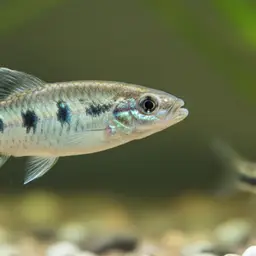
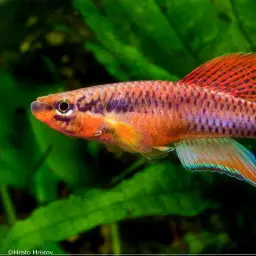
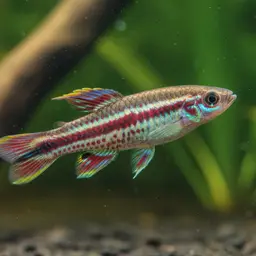
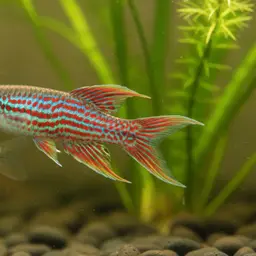
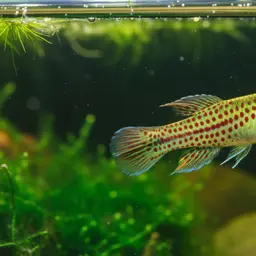
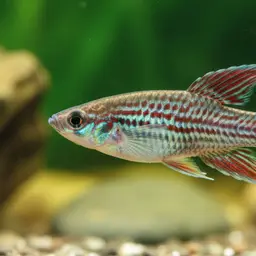
Good tank mates
Species that tend to coexist peacefully with Japanese medaka
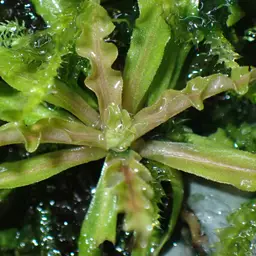
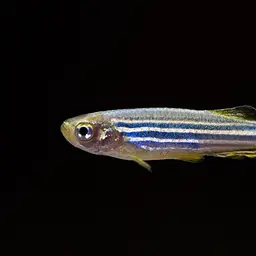
From the same region
Share the same natural habitat. Great for a biotope-themed tank


Frequently asked questions
- How big does the Japanese medaka get?
- The Japanese medaka reaches about 1–1.5" as an adult.
- What size tank does the Japanese medaka need?
- A minimum of 11 gallons is recommended for the Japanese medaka.
- What water parameters does the Japanese medaka need?
- The Japanese medaka does best with a temperature of 60–84°F, a pH of 6–8.5, hardness around 4–25 dGH.
- Is the Japanese medaka aggressive?
- The Japanese medaka is generally peaceful and suits a community tank with similarly calm tankmates.
- What does the Japanese medaka eat?
- The Japanese medaka is an omnivore. It does well on a varied diet of quality flake or pellet plus occasional frozen or live foods.
- How long does the Japanese medaka live?
- With good care, the Japanese medaka typically lives 4-8 years.