Banded Banjo
Platystacus cotylephorus
A leaf-mimicking catfish that carries its eggs on fleshy belly stalks.

About
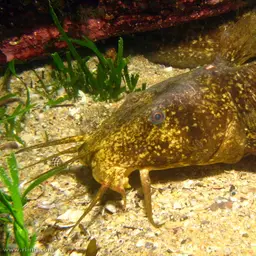
The banded banjo (Platystacus cotylephorus) is one of those fish that genuinely makes you do a double-take. Its flattened, mottled body is shaped to resemble a dead leaf so convincingly that it will simply drift motionless in the current when released into a tank, rather than swim. Native to coastal river systems from Venezuela down into northern Brazil, it lives primarily in brackish, turbid shallows near river mouths, where blending into soft, muddy substrates is a serious survival strategy. This species is largely nocturnal and secretive, spending daylight hours hidden and nearly immobile, so it is best suited to a keeper who appreciates unusual behavior over constant activity. At feeding time after lights-out, though, it becomes noticeably more animated. What really sets this fish apart is its reproductive biology: spawning females develop clusters of fleshy, stem-like structures called cotylephores on their undersides, and eggs attach directly to these, possibly receiving oxygen or nutrients through them. A mammal-like arrangement that is almost unheard of among fish. Breeding in captivity has rarely been completed, though egg-carrying females have occasionally been imported successfully. A peaceful species that gets along with its own kind, it is a rewarding project fish for intermediate keepers with a taste for the genuinely unusual.
Similar species
Other fish you might consider
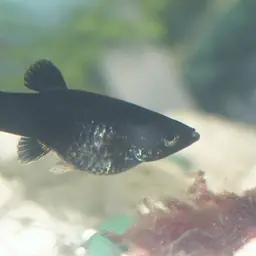

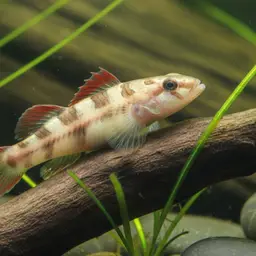
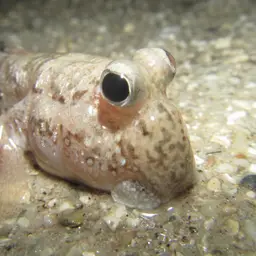
Good tank mates
Species that tend to coexist peacefully with Banded Banjo


From the same region
Share the same natural habitat. Great for a biotope-themed tank
Frequently asked questions
- How big does the Banded Banjo get?
- The Banded Banjo reaches about 7.5–13" as an adult.
- What size tank does the Banded Banjo need?
- A minimum of 29 gallons is recommended for the Banded Banjo.
- What water parameters does the Banded Banjo need?
- The Banded Banjo does best with a temperature of 68–82°F, a pH of 6–8.2, hardness around 5–35 dGH.
- Is the Banded Banjo aggressive?
- The Banded Banjo is generally peaceful and suits a community tank with similarly calm tankmates.
- What does the Banded Banjo eat?
- The Banded Banjo is an omnivore. It does well on a varied diet of quality flake or pellet plus occasional frozen or live foods.
- How long does the Banded Banjo live?
- With good care, the Banded Banjo typically lives 8-12 years.