Teri Barb
Puntius terio
Also known as: One spot barb, Onespot Barb
A peaceful, adaptable schooling barb that's surprisingly rare in the trade given its wide range.

About
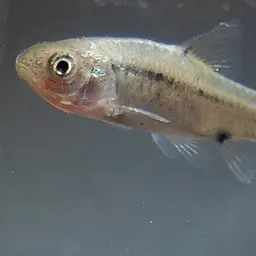
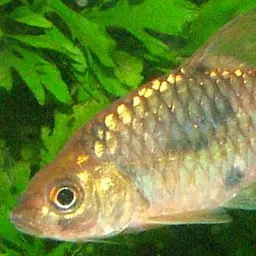
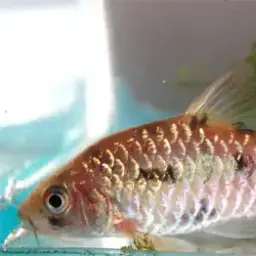
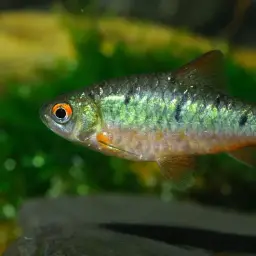
The Teri Barb (Puntius terio), also known as the Onespot Barb, is a small cyprinid native to a broad swathe of South and Southeast Asia, with populations recorded across Pakistan, India, Bangladesh, and Myanmar. In the wild it turns up in a wide variety of habitats, rivers, canals, ponds, ditches, and flooded fields, often over silty or muddy substrates, which speaks to just how adaptable this fish is. Identification is fairly consistent across populations: look for a diffuse yellow-golden wash on the gill cover and a dark spot on the caudal peduncle, usually ringed with a golden-yellow halo. The dorsal fin frequently shows irregular dark spots or streaks that can merge into a rough longitudinal band. Despite its wide natural distribution and genuine suitability for community tanks, the Teri Barb remains uncommon in the hobby, which is something of a puzzle. It's a genuinely forgiving choice for newer keepers, tolerating a broad range of water conditions and mixing well with a huge variety of tankmates. Other small cyprinids, tetras, livebearers, rainbowfish, anabantoids, catfish, and loaches all work. Like most barbs, it's a schooling species at heart, and keeping a group of eight to ten individuals brings out calmer behavior and better coloration, especially in males competing for the attention of females.
Similar species
Other fish you might consider
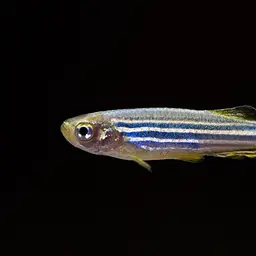
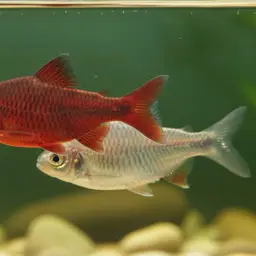
Good tank mates
Species that tend to coexist peacefully with Teri Barb
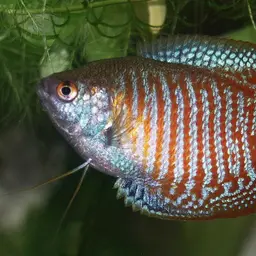
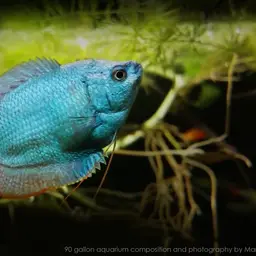
From the same region
Share the same natural habitat. Great for a biotope-themed tank
Frequently asked questions
- How big does the Teri Barb get?
- The Teri Barb reaches about 2.5–4" as an adult.
- What size tank does the Teri Barb need?
- A minimum of 19 gallons is recommended for the Teri Barb, with more room needed for a proper group.
- What water parameters does the Teri Barb need?
- The Teri Barb does best with a temperature of 64–82°F, a pH of 6.5–8, hardness around 2–30 dGH.
- Is the Teri Barb aggressive?
- The Teri Barb is generally peaceful and suits a community tank with similarly calm tankmates.
- What does the Teri Barb eat?
- The Teri Barb is an omnivore. It does well on a varied diet of quality flake or pellet plus occasional frozen or live foods.