Saddle Barb
Barbodes banksi
A rare Bornean barb with a distinctive wedge marking, seldom seen outside specialist circles.

About
A small-stream cyprinid from the lowlands and foothills of Malaysia and Indonesia, Barbodes banksi is one of those species that turns up in the hobby more by accident than design. Most specimens enter the trade as bycatch tucked inside shipments of commoner fish. It belongs to a genus that was reshuffled out of the old catch-all Puntius grouping, and its own species boundaries are still a little fuzzy: some researchers suspect it may simply be a colour variant of the closely related B. binotatus rather than a fully distinct species. The feature that separates the two is a dark, wedge-shaped marking on each flank just below the dorsal fin. Sometimes appearing as a vertical bar in juveniles, occasionally persisting in that form into adulthood. In the aquarium, this is a relaxed, active fish that does best in groups of six or more, where individuals become noticeably bolder and any minor squabbling stays contained within the group's social order. It suits a peaceful riverine community alongside similar-sized cyprinids and botiid or nemacheilid loaches, provided tankmates are confident enough not to be unnerved by its energy levels. Clear, well-oxygenated water and a planted setup will keep it comfortable, and its undemanding diet makes it a reasonable choice for less experienced keepers who can actually track one down.
Similar species
Other fish you might consider
Good tank mates
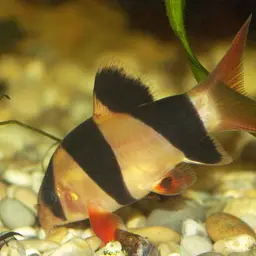
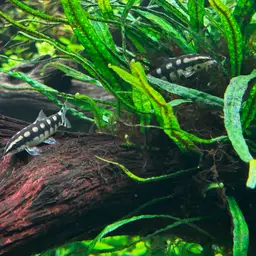
Species that tend to coexist peacefully with Saddle Barb

From the same region
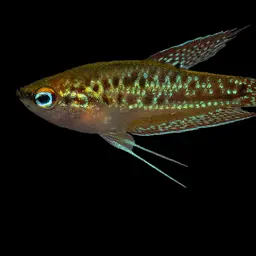
Share the same natural habitat. Great for a biotope-themed tank
Frequently asked questions
- How big does the Saddle Barb get?
- The Saddle Barb reaches about 3–4.5" as an adult.
- What size tank does the Saddle Barb need?
- A minimum of 43 gallons is recommended for the Saddle Barb, with more room needed for a proper group.
- What water parameters does the Saddle Barb need?
- The Saddle Barb does best with a temperature of 70–82°F, a pH of 6–7.5, hardness around 2–12 dGH.
- Is the Saddle Barb aggressive?
- The Saddle Barb is generally peaceful and suits a community tank with similarly calm tankmates.
- What does the Saddle Barb eat?
- The Saddle Barb is an omnivore. It does well on a varied diet of quality flake or pellet plus occasional frozen or live foods.