Blue Caribe
Serrasalmus altuvei
A rare, solitary piranha relative that's harder to identify than to keep.

About
Found lurking in the Orinoco River basin of Venezuela, the blue caribe (Serrasalmus altuvei) is one of those fish that turns up more often as a mislabeled import than as a deliberate purchase. Juveniles are frequently mixed in with shipments of S. rhombeus and sold without anyone realizing. It belongs to what taxonomists call the "compressed group" within the genus, a cluster of morphologically similar species that can be genuinely difficult to tell apart. Its closest lookalike is S. compressus, and the main way to separate them as juveniles is by looking at the flank spotting: in this species the spots stay mostly above the lateral midline, while S. compressus has denser speckling that extends further down the belly and flanks. Adults are a compact, deep-bodied fish that seldom exceed seven inches. Despite its fearsome reputation by association, the blue caribe is typically shy and easily startled in captivity. The media depiction of piranha relatives as aggressive monsters is a long way from reality. That said, it is absolutely a one-fish-per-tank animal. It won't reliably coexist with tankmates, and keeping two together almost invariably ends badly. Plan for a long commitment too: these fish routinely live over a decade and slow down noticeably with age.
Similar species
Other fish you might consider
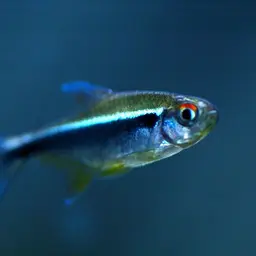
Good tank mates
Species that tend to coexist peacefully with Blue Caribe
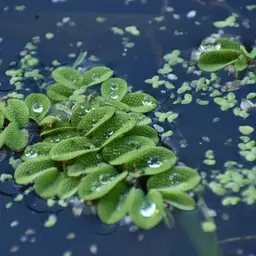
From the same region
Share the same natural habitat. Great for a biotope-themed tank

Frequently asked questions
- How big does the Blue Caribe get?
- The Blue Caribe reaches about 4–7" as an adult.
- What size tank does the Blue Caribe need?
- A minimum of 67 gallons is recommended for the Blue Caribe.
- What water parameters does the Blue Caribe need?
- The Blue Caribe does best with a temperature of 100–100°F, hardness around 2–15 dGH.
- Is the Blue Caribe aggressive?
- The Blue Caribe is semi-aggressive. It can work in a community with careful tankmate choices and enough space.