Blue Cheek Dwarf Cichlid
Apistogramma eunotus
A compact Peruvian dwarf cichlid with serious parenting instincts and big personality.

About
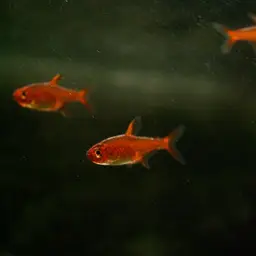
Found across a surprisingly broad range of water types in the western Amazon basin, Apistogramma eunotus turns up in blackwater, clearwater, and whitewater tributaries of the Ucayali, Amazon, Yavarí, and Japurá rivers in Peru and Brazil. That adaptability to varied water chemistry is one of its more useful traits in the aquarium, giving keepers some flexibility. Males are the larger and more colorful sex, as is typical for the genus, while females stay notably smaller and take on a yellowish hue when guarding a spawn. Breeding follows the classic Apistogramma cave-spawning pattern. Eggs are deposited on the ceiling of a small cavity or crevice, and the female takes full charge of the eggs and fry from that point on. In smaller tanks she can become genuinely aggressive in this role, and removing the male after spawning is often the safer option. For general community keeping, captive-raised fish settle in far more readily than wild-caught specimens, which do better in a quieter setup with small dither fish like pencilfish to make them feel secure. Mixing this species with other Apistogramma is generally not recommended. It sits within a taxonomically complex group, and hobbyists often track collection locality carefully to avoid accidental hybridization with closely related forms.
Similar species
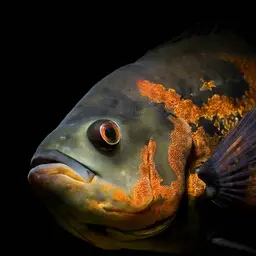
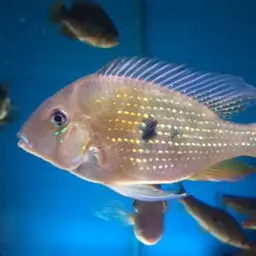
Other fish you might consider
Good tank mates
Species that tend to coexist peacefully with Blue Cheek Dwarf Cichlid
From the same region
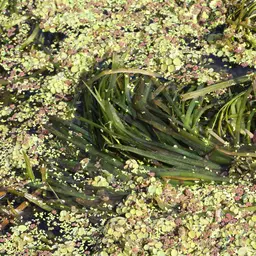
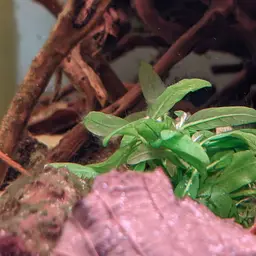
Share the same natural habitat. Great for a biotope-themed tank
Frequently asked questions
- How big does the Blue Cheek Dwarf Cichlid get?
- The Blue Cheek Dwarf Cichlid reaches about 1.5–2.5" as an adult.
- What size tank does the Blue Cheek Dwarf Cichlid need?
- A minimum of 11 gallons is recommended for the Blue Cheek Dwarf Cichlid.
- What water parameters does the Blue Cheek Dwarf Cichlid need?
- The Blue Cheek Dwarf Cichlid does best with a temperature of 72–86°F, a pH of 5.5–7.5, hardness around 1–10 dGH.
- Is the Blue Cheek Dwarf Cichlid aggressive?
- The Blue Cheek Dwarf Cichlid is semi-aggressive. It can work in a community with careful tankmate choices and enough space.
- What does the Blue Cheek Dwarf Cichlid eat?
- The Blue Cheek Dwarf Cichlid is a carnivore. It needs a meaty, protein-rich diet of frozen or live foods.
- How long does the Blue Cheek Dwarf Cichlid live?
- With good care, the Blue Cheek Dwarf Cichlid typically lives 3-5 years.