Dwarf Angelfish
Pterophyllum leopoldi
Also known as: Leopoldi Angelfish, Leopold's Angelfish, Teardrop Angelfish
The smallest wild angelfish, with a bold Roman nose and surprising attitude.

About
Found along stretches of the Solimões River between Manacapuru and Santarém, as well as the Rupununi River in Guyana, this compact cichlid, Pterophyllum leopoldi, is the smallest of the three wild angelfish species and also arguably the most distinctively marked. Up to eleven vertical body stripes are present, though typically only the three boldest are clearly visible at any given time. A dark smudge over the gill cover and, in mature fish, a warm reddish-maroon wash across the back and fins set it apart from its more commonly kept relatives. The steeply curved forehead, the so-called Roman nose, is the most reliable identification feature and gives the fish an immediately recognizable profile. Despite its smaller size, it carries a notably feisty personality toward its own kind, more so than other angels, so keeping a larger group helps distribute any aggression rather than letting one fish bear the brunt of it. Its modest stature actually makes it a reasonable companion for medium-sized tetras, corydoras, dwarf cichlids, and similar soft-water community fish that would otherwise be at risk with larger angels. Breeding follows typical angelfish patterns. Pairs form naturally within a group, spawn on vertical surfaces, and are attentive parents, though well-fed adults are less likely to turn on their own fry.
Similar species
Other fish you might consider
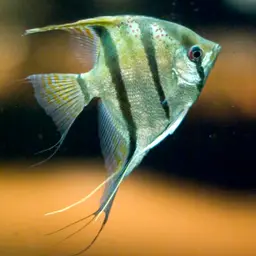
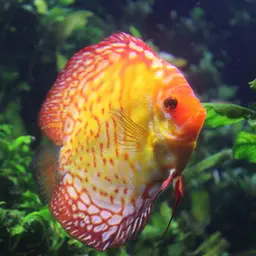
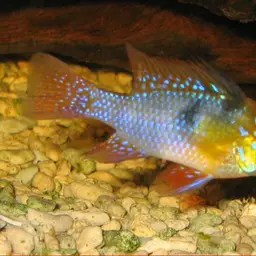
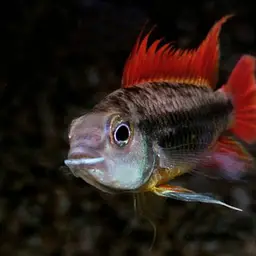
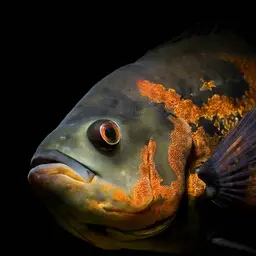
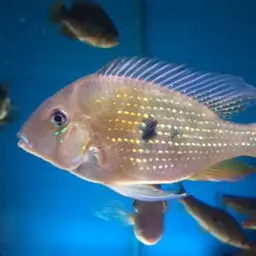
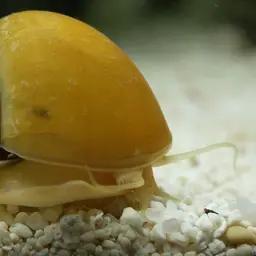
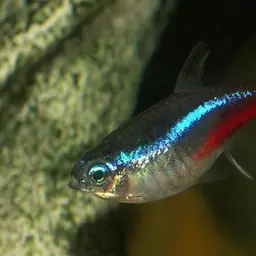
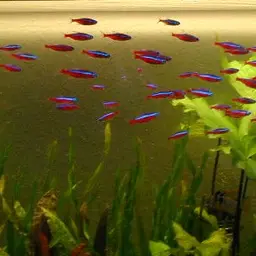
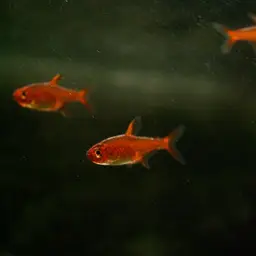
Good tank mates
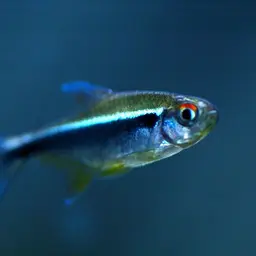
Species that tend to coexist peacefully with Dwarf Angelfish
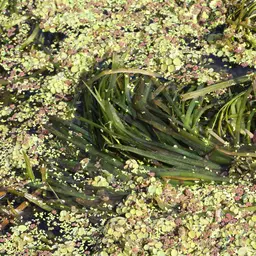
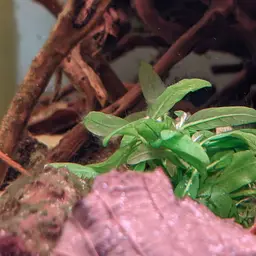
From the same region
Share the same natural habitat. Great for a biotope-themed tank
Frequently asked questions
- How big does the Dwarf Angelfish get?
- The Dwarf Angelfish reaches about 1–2.5" as an adult.
- What size tank does the Dwarf Angelfish need?
- A minimum of 11 gallons is recommended for the Dwarf Angelfish.
- What water parameters does the Dwarf Angelfish need?
- The Dwarf Angelfish does best with a temperature of 75–84°F, a pH of 4.5–7.5, hardness around 1–10 dGH.
- Is the Dwarf Angelfish aggressive?
- The Dwarf Angelfish is semi-aggressive. It can work in a community with careful tankmate choices and enough space.
- What does the Dwarf Angelfish eat?
- The Dwarf Angelfish is an omnivore. It does well on a varied diet of quality flake or pellet plus occasional frozen or live foods.
- How long does the Dwarf Angelfish live?
- With good care, the Dwarf Angelfish typically lives 5-10 years.