Red Barred Killi
Aphyosemion elberti
A small, manageable killifish with bold markings from Central African stream systems.

About
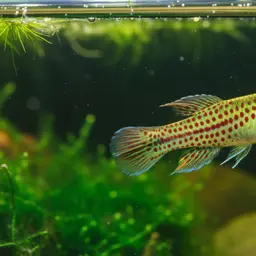
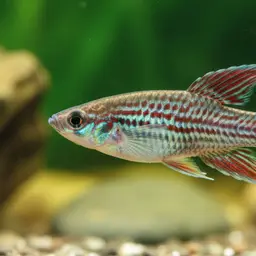
The Red Barred Killi (Aphyosemion elberti) is a compact killifish native to a surprisingly wide stretch of Central and West Africa, with wild populations documented across the upper Benue and Logone river systems as well as the Sanaga basin and the Mambere drainage, spanning Nigeria, Cameroon, and the Central African Republic. That broad natural range hints at a fish that handles varied conditions reasonably well, and indeed this species is considered a workable choice for keepers new to the killifish group. Males display the vivid red barring that gives the fish its common name, making them noticeably more ornate than the plainer females, which is typical for the Aphyosemion genus. Like most of its relatives, it is an egg-layer, and the breeding process is one of the genuine appeals of keeping killifish for hobbyists who want to try something beyond livebearers. In the wild it occupies soft, shaded forest streams and similar slow-moving habitats, so a planted tank with subdued lighting suits it well. It is an omnivore and not particularly fussy about food, accepting small live, frozen, and prepared items without much coaxing. Given its small adult size, a modest tank is perfectly adequate, but keep the lid on tight. Killifish are accomplished jumpers.
Similar species
Other fish you might consider
Good tank mates
Species that tend to coexist peacefully with Red Barred Killi
From the same region
Share the same natural habitat. Great for a biotope-themed tank
Frequently asked questions
- How big does the Red Barred Killi get?
- The Red Barred Killi reaches about 1–1.5" as an adult.
- What water parameters does the Red Barred Killi need?
- The Red Barred Killi does best with a temperature of 64–75°F, a pH of 6–7.2, hardness around 2–10 dGH.
- Is the Red Barred Killi aggressive?
- The Red Barred Killi is generally peaceful and suits a community tank with similarly calm tankmates.
- What does the Red Barred Killi eat?
- The Red Barred Killi is an omnivore. It does well on a varied diet of quality flake or pellet plus occasional frozen or live foods.