L239
Baryancistrus beggini
A tiny, dark-bodied pleco with an iridescent blue sheen from Guyana Shield rapids.

About
Formerly known in the trade as L239, Baryancistrus beggini is a compact loricariid catfish native to the rocky, fast-moving waters of Venezuela and Colombia, where it scrapes periphyton and associated microfauna from the surfaces and undersides of granite boulders along exposed sections of the Guyana Shield. Its appearance is quite distinctive within the pleco world: the body is uniformly dark brown to black, overlaid with a subtle turquoise to bluish sheen, and a noticeable keel runs along the lower flanks, formed by the angled shape of several midventral body plates above the pectoral fins. It stays small by pleco standards, which makes it workable in modest setups without the usual concerns about a suckermouth outgrowing the tank. Despite being labeled beginner-appropriate in terms of basic care, it is not a fish for a generic community setup. It can be territorial toward its own kind and toward other similar-looking plecos, particularly male-to-male, though its small size means a group can sometimes be managed in a larger tank with adequate rockwork and sight breaks. Keeping it alongside small, non-competing characids tends to work well. Breeding follows the typical loricariid cave-spawning pattern, with the male taking sole responsibility for guarding eggs after the female is driven away.
Similar species
Other fish you might consider
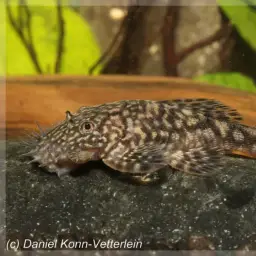
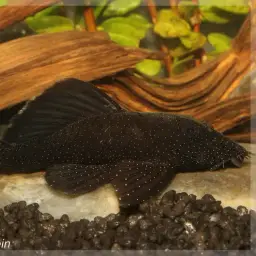
Good tank mates
Species that tend to coexist peacefully with L239
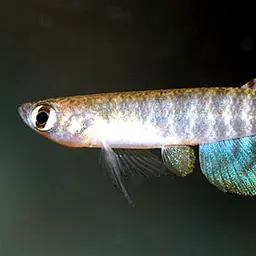
From the same region
Share the same natural habitat. Great for a biotope-themed tank

Frequently asked questions
- How big does the L239 get?
- The L239 reaches about 2–3" as an adult.
- What size tank does the L239 need?
- A minimum of 19 gallons is recommended for the L239.
- What water parameters does the L239 need?
- The L239 does best with a temperature of 75–86°F, a pH of 5.5–7.5, hardness around 1–12 dGH.
- Is the L239 aggressive?
- The L239 is aggressive and is best kept alone or with robust tankmates that can hold their own.
- What does the L239 eat?
- The L239 is a herbivore. It needs a plant-based diet such as algae, blanched vegetables, or spirulina-based foods.