Tombstone Coral
Coeloseris mayeri
A solid, slow-growing mound coral with a quietly geometric look.

About
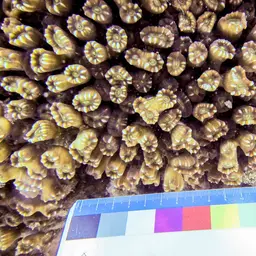
Tombstone coral (Coeloseris mayeri) is one of those understated reef-builders that tends to get overlooked in favor of flashier species, but it has a quiet architectural appeal that grows on you. Colonies form dense, rounded or gently hummocked masses with a surface pattern of tightly packed corallites arranged in a way that recalls Siderastrea. Neat, almost geometric rows of septo-costae meeting at the walls without a central columella. The overall effect is orderly and textured rather than ornate. Coloration runs toward the subdued end of the spectrum: pale greens, yellows, and browns are typical, usually with calices that are slightly darker than the surrounding tissue. Like many large-polyp and massive corals, it only extends its tentacles after dark, so don't expect much visible polyp activity during the day. In the wild, this species occupies shallow upper reef slopes and lagoons across a broad Indo-Pacific range, from the Red Sea out into the central Pacific, at depths from the surface down to around 40 meters. In the aquarium it suits an intermediate keeper comfortable with stable reef conditions. Moderate lighting and flow work well, and its solid, encrusting growth form means it won't need much repositioning once settled in.
Similar species
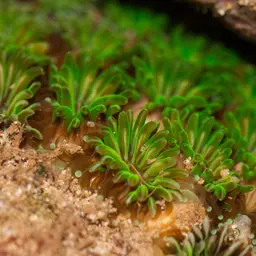
Other coral you might consider
Good tank mates
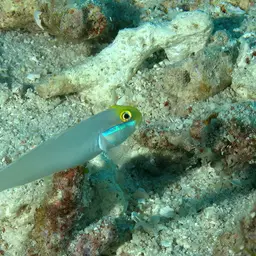
Species that tend to coexist peacefully with Tombstone Coral
From the same region
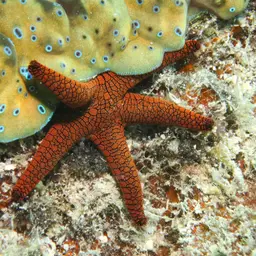
Share the same natural habitat. Great for a biotope-themed tank
Frequently asked questions
- What water parameters does the Tombstone Coral need?
- The Tombstone Coral does best with a temperature of 72–78°F, a pH of 8.1–8.3.
- Is the Tombstone Coral aggressive?
- The Tombstone Coral is generally peaceful and suits a community tank with similarly calm tankmates.
- What does the Tombstone Coral eat?
- The Tombstone Coral is a filter feeder. It eats tiny particles suspended in the water and usually needs target feeding in a home tank.
- Is the Tombstone Coral reef safe?
- The Tombstone Coral is generally considered reef safe.