Aquariumpro
πŸ”
← Back to species
FishFreshwaterBrackishBeginnerPeaceful

Swordtail

Xiphophorus hellerii

Also known as: Green swordtail

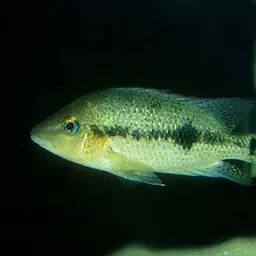
The elongated tail sword makes males one of the most recognizable livebearers in the hobby.

Swordtail
1 / 16
CC BY-SA 3.0

About

The swordtail (Xiphophorus hellerii) is one of those fish that almost every hobbyist has kept or at least considered, and for good reason. Males carry that unmistakable elongated lower tail fin, the "sword", that gives the species its name, and decades of selective breeding have produced an enormous range of color forms and fin variations well beyond the natural olive-green wild type. Females are larger-bodied but lack the sword entirely. In the wild, this species ranges from Veracruz in Mexico down through northwestern Honduras, where it inhabits fast-moving, heavily vegetated streams and rivers, warm springs, and weedy canals. It feeds opportunistically on insects, worms, crustaceans, and plant material. Like all poeciliids, fertilization is internal. Males use a modified anal fin called a gonopodium, and females can store viable sperm for months, meaning a single female can produce multiple broods long after any contact with a male. In the aquarium, females and males of other species get along fine, but males can be persistently aggressive with one another, forming dominance hierarchies that take up a surprising amount of their time. Keep that in mind if you're planning a group. A single male or a larger mixed group with plenty of cover tends to work better than two or three males together. Swordtails are a forgiving and rewarding choice for newer fishkeepers.

Varieties & strains

12 recognized strains of Swordtail.

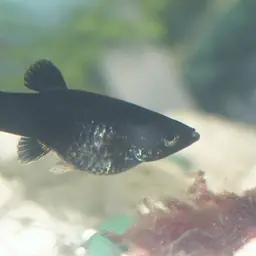
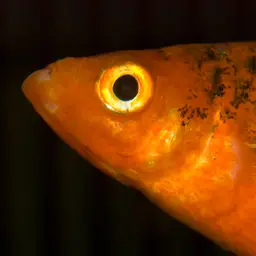
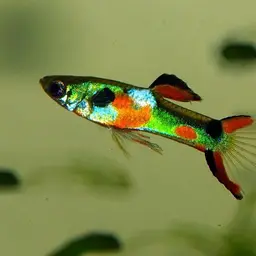
Red SwordtailThe classic hobby swordtail β€” body is a solid, saturated brick-to-cherry red with a yellow-edged sword on the male. Females are plumper and swordless but carry the same red coloration. This is the benchmark strain; if the red looks washed-out or patchy at the store, pass on it. Well-bred individuals should show even color from gill plate to caudal peduncle with no white belly creep. One of the hardiest ornamental strains available, tolerating a wide pH range and forgiving of beginner mistakes. A mainstay of the hobby for over a century.Green SwordtailMales display an olive-to-bronze body with a distinct red or dark lateral stripe running from behind the eye to the caudal peduncle, and a sword that is yellow-green with a black edge. The overall look is subtler than red strains but highly attractive under good lighting. This strain sits closest to the wild-type pattern while still being a product of selective breeding for consistent coloration and finnage. Look for a clearly defined lateral stripe and a clean sword edge β€” faded striping usually indicates poor-quality stock. Adapts well to planted tanks.Black SwordtailA striking, dark strain where heavy melanophore expression covers most of the body in deep black or charcoal, often with a subtle iridescent sheen under light. Males carry a black-edged sword that blends dramatically into the body. The best specimens are nearly uniform black with minimal mottling or pale patches on the flanks. Be aware that pure black swordtails can be prone to melanoma β€” a real concern with highly melanistic lines β€” so source from reputable breeders who cull aggressively. Pairs beautifully with high-contrast tankmates in a well-lit aquascape.Wagtail SwordtailThe defining trait here is the jet-black fins against a body that can be almost any base color β€” most commonly red or red-and-white. Every fin, including dorsal, anal, pectoral, and the sword, is solidly pigmented black, creating a bold contrast that reads clearly even across a large tank. The 'wagtail' pattern is a genetic modifier layered over existing body-color strains, so you'll see red wagtail, pineapple wagtail, and so on. When selecting, prioritize specimens where the black fin coloration is dense and unbroken rather than faded or peppered. A staple of the pet trade.Marigold SwordtailA warm, golden-orange strain that ranges from pale lemon-yellow to deep amber depending on the line. Males have a sword that grades from gold at the base to yellow at the tip, often edged in black. The coloration is produced by xanthophore pigment expression without red dominance, giving the fish a distinctly sunny, warm tone rather than the fiery look of the red strain. Feed high-carotenoid foods to sustain color intensity β€” it can fade in fish kept on plain flake diets. A beautiful mid-tank fish that catches light exceptionally well.Pineapple SwordtailNamed for its yellow-gold body overlaid with a reddish or orange tint and scattered dark scale edging that gives a slightly netted or 'pineapple skin' texture on close inspection. Males have a bright yellow sword with a dark lower edge. The color sits between marigold and red β€” warmer than marigold, less saturated than true red. It's a visually complex strain that rewards close-up viewing. Quality varies widely in mass-market fish; look for even scale patterning and a clearly defined sword. Pairs well with both red and black strains for a colorful community.Neon SwordtailFeatures a vivid electric-blue or teal iridescent horizontal stripe running the length of the body, contrasting against a red or orange base color. The neon effect comes from structural iridophore coloration rather than pigment, so it shifts intensity depending on viewing angle and lighting. Under LED lighting it can look genuinely striking. This is one of the more recently stabilized ornamental swordtail strains; quality can be inconsistent between batches, so inspect the iridescent stripe carefully β€” it should be continuous and bright, not broken or pale. A standout in community tanks.Tuxedo SwordtailThe rear half of the body β€” from roughly mid-flank back β€” is strongly darkened with black or dark gray pigmentation, while the front half retains the base body color (commonly red or orange), creating a two-tone 'tuxedo' split. On a well-bred male the division between light and dark zones is clean and sharp, not blurry or mottled. The sword is typically dark-edged. Tuxedo is a dominant genetic pattern that has been crossed into many color strains; you'll encounter red tuxedo, gold tuxedo, and others. Select for a clearly defined color boundary for the most dramatic effect.Kohaku SwordtailDirectly inspired by koi color aesthetics β€” the Kohaku pattern displays a white or cream base body with bold red-orange patches distributed across the flanks, head, and back. The best specimens mirror the balanced red-on-white pattern prized in koi, with patches that are sharply defined and not muddy. Pattern placement is random and varies fish to fish, which is part of the appeal. Males have a clear sword, often white or lightly colored. This is a strain where individual fish vary enormously; hand-picking from a healthy batch pays off. A conversation piece in any community setup.Lyretail SwordtailThe lyretail mutation extends the top and bottom lobes of the caudal fin into elongated, symmetrical streamers, so instead of a simple sword projecting from the lower caudal lobe, both lobes are drawn out, giving the tail a lyre or double-sword silhouette. This fin form can be combined with virtually any body-color strain. The extended finnage is spectacular but does require extra attention to water quality β€” long fins are more prone to fin rot in suboptimal conditions. Also avoid aggressive or nippy tankmates. Males are still fertile despite the modified caudal structure.Berlin SwordtailA red-and-black bicolor strain where the body shows bold, irregular black markings or a heavy black reticulation over a red base, creating a mosaic-like pattern more complex than the clean two-tone of the tuxedo. Some descriptions place the Berlin as a specific line with a characteristic black dorsal and heavy flank spotting. It's one of the more variable strains in terms of pattern expression β€” no two fish look identical. Developed with show-quality standards in mind; well-bred Berlins are noticeably more refined in body shape and finnage than mass-market fish.Hi-Fin SwordtailThe hi-fin (or Simpson hi-fin) mutation produces a dramatically enlarged dorsal fin β€” often nearly as tall as the body is deep β€” that flows and waves with every movement of the fish. It can be combined with any body-color strain and is genuinely eye-catching in a calm, well-planted tank. The oversized dorsal is a recessive trait and fish are fully robust when kept in appropriate conditions, but the fin is physically vulnerable: keep water pristine, avoid fin nippers, and ensure gentle flow so the fin doesn't get shredded on equipment. Males are slightly less active swimmers than standard-fin siblings.

Frequently asked questions

How big does the Swordtail get?
The Swordtail reaches about 3.5–6" as an adult.
What size tank does the Swordtail need?
A minimum of 26 gallons is recommended for the Swordtail.
What water parameters does the Swordtail need?
The Swordtail does best with a temperature of 64–82Β°F, a pH of 7–8, hardness around 9–25 dGH.
Is the Swordtail aggressive?
The Swordtail is generally peaceful and suits a community tank with similarly calm tankmates.
What does the Swordtail eat?
The Swordtail is an omnivore. It does well on a varied diet of quality flake or pellet plus occasional frozen or live foods.
How long does the Swordtail live?
With good care, the Swordtail typically lives 3-4 years.